Suomi 100 satellite's five busy years in space
3 December 2023
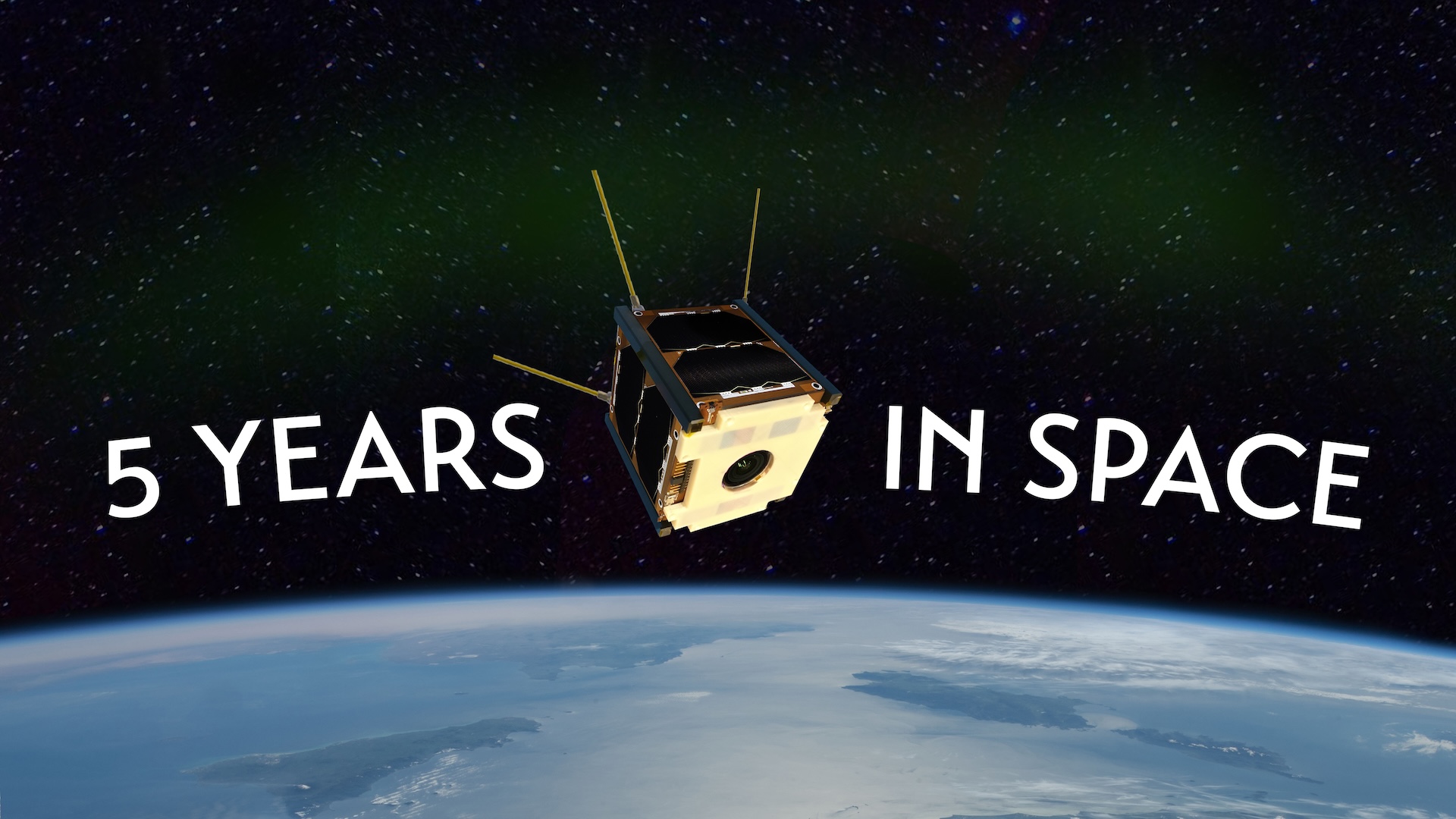
The Suomi 100 satellite was launched into space on 3 December 2018 from California on SpaceX's Falcon 9 launcher. The launch went well and the connection to the satellite was established almost immediately
Even after that, everything has gone well. The satellite is still operational, we communicate with it daily, and its next more intense period of operation begins on 7 December, when the next EISCAT heating experiment is due.
These synchronised observations with the of the EISCAT Research Network's heating antenna in Norway near Tromsø have been the most interesting observations the Suomi 100 satellite has made.
In the experiments, a large antenna is used to heat the ionosphere near the Earth, and with the satellite is making measurements when it is flying through the heated area.
Heating is very weak – it doesn't harm the environment. Even though one can consider this like creating artificial northern lights, they are far too faint to be seen with the naked eye. The Suomi 100 satellite's sensitive radio instrument, on the other hand, can detect the heating effects.
Similar experiments have taken place in the past. The first heating campaign with Suomi 100 satellite was in December 2020.
"This time, the difference to previous measurement campaigns is that at the same time as the Suomi 100 satellite, another research satellite is also flying near the heating area," says the Suomi 100 satellite project's leader, professor Esa Kallio from Aalto University.
"Furthermore, the Sun is now more active than ever during the satellite's five-year stay in space. The activity has an effect on the properties of the ionosphere and thus also on the appearance of the aurorae."
Although the Suomi 100 satellite also includes a camera, it hasn't been used frequently. The pictures were taken especially in the early stages of the flight, but since these are not of great scientific importance, the resources have been concentrated on the radio measurements, which have proven to be very interesting. The results have already been published in numerous research reports.
The satellite's radiometer operates in the MF/HF frequency range and detects radio waves from the ionosphere as well as from the earth's surface. The ionosphere is a zone of charged particles surrounding the Earth and it adapts to the solar wind, i.e. particles coming from the Sun. The ionosphere also affects man-made radio transmissions, so by listening to them you can find out the properties of the ionosphere.
The sounds of the radio observations and satellite images are available on the measurements (mittaukset in Finnish) page.
The Suomi 100 satellite is currently orbiting the Earth at an altitude of roughly 570 kilometers on polar orbit. One round takes about 97 minutes, and the satellite passes Finland in this orbit about three times a day.
If nothing surprising happens, the satellite will be in operation for almost a decade. It is clearly one of the longest-lasting and clearly the most high-flying of the projects that received funding for Finland's 100th anniversary organisation!


